
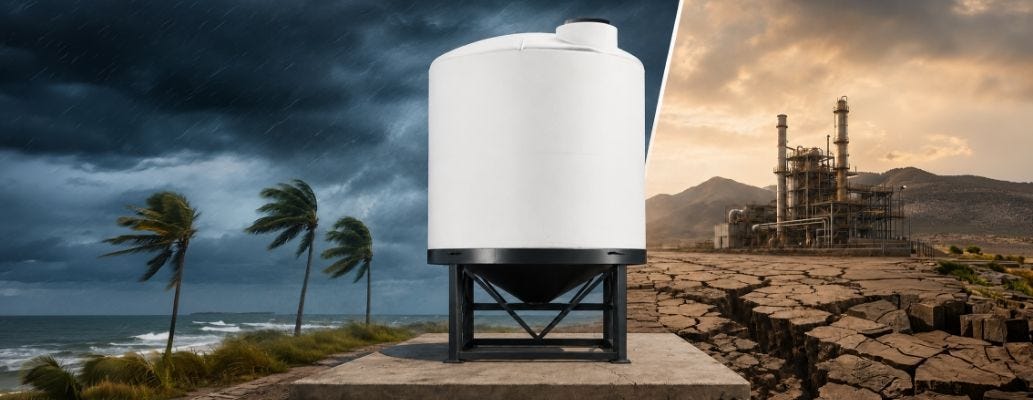
Seismic vs. Wind Load: Choosing a Cone Bottom Tank Stand That Stays Put
Two forces decide whether an elevated cone bottom tank rides out a storm or an earthquake: wind and seismic load. Here is how to tell which one rules your site, and how to spec a stand and tie-down that holds.
A cone bottom tank does its best work up in the air. Lift it onto a stand and gravity drains every last gallon out the bottom. No pump, no waste, no residue left to spoil. But the moment you put a full tank on legs, you create a new problem. You have raised a heavy load off the ground and asked a steel or poly frame to hold it there through everything nature throws at it. Two forces decide whether that stand stays standing: wind and earthquakes. They pull in different ways, they peak at different moments, and the one that matters most depends entirely on where you set the tank down. Get the match right and the tank rides out a storm or a shake without moving. Get it wrong and you are cleaning up a few thousand gallons of product, plus the tank, plus whatever it landed on.
This guide breaks down how wind load and seismic load act on an elevated cone bottom tank, how to tell which one rules your site, and how to spec a stand and tie-down system that holds. No engineering degree required.
The stand is the part that fails first
Most people shop the tank. The smart money shops the stand.
A cone bottom tank is usually made from tough polyethylene, rotationally molded in one piece, so the tank body itself rarely fails. The stand is a different story. It carries the full weight of the tank and its contents, sometimes 8 pounds, sometimes almost 16 pounds for every gallon [about 1 to 1.9 kg per liter], depending on what you store. A 1,000 gallon [3,785 liter] tank of a heavy liquid can put more than 15,000 pounds [6,800 kg] on four legs and their anchor points. So when an elevated tank goes down, it almost never fails at the tank. It fails at the legs, at the bolts, or at the pad. That is good news, because those are the exact parts you control when you buy. Spend your attention there.
Two forces, two very different attacks
Wind and earthquakes both try to knock your tank over, but they do it in opposite ways.
Wind pushes sideways and lifts. It is a steady, outside shove against the whole profile of the tank and stand. A tall tank on a stand acts like a sail. The taller and emptier the tank, the worse it gets, because an empty tank is light enough to tip or even lift off a poorly anchored pad. Wind load is usually the boss on hurricane coasts, across open farmland, and anywhere flat with nothing to break the gusts.
An earthquake works from the ground up. It shakes the base back and forth while the mass up top wants to stay put, so the stand takes a violent side-to-side whipping. Worse, the liquid inside sloshes. That moving liquid slams against the tank walls and adds force the static weight never shows on paper. Seismic load is the boss across California and other shake-prone regions, and it punishes tall, top-heavy setups hardest.
Here is the key point: an empty tank is the wind problem, and a full tank is the earthquake problem. Empty tanks blow over. Full tanks shake loose. A good stand and tie-down plan has to answer both, not just the one you happen to worry about.
Which force governs your site?
You do not get to pick. Your ZIP code picks for you, and the building code writes it down.
Engineers use a national standard called ASCE 7 to size both loads. It sorts every site into a Seismic Design Category from A to F, where F is the most severe, based on local ground-shaking maps and how critical the tank is to safety. It does the same for wind using mapped wind-speed zones. Your local building department adopts these rules, so the question of which force wins is often already answered on paper before you buy a thing.
A few rules of thumb:
- Coastal and hurricane country (the Gulf Coast, Florida, the Southeast): wind almost always governs, with design winds often in the 110 to 150 mph [177 to 241 km/h] range.
- Open plains and farmland (Texas, Oklahoma, the Midwest): wind again, with few obstructions to slow the gusts.
- California and the seismic West: earthquakes govern, often landing sites in the higher Seismic Design Categories that demand real anchorage.
- Many industrial sites face both, and the stand simply has to satisfy the tougher of the two. You do not need to run the math yourself.
You do need to know your Seismic Design Category and your design wind speed before you spec a stand, because those two numbers decide how much tie-down you need.
Anchorage is the whole ballgame
You can buy the strongest stand on the lot and still lose the tank if it is not tied down right. In almost every failure, the breakdown is at a connection: the tank to the stand, the stand to the pad, or the pad to the earth. Three things make anchorage work.
- A level concrete pad. A stand is only as stable as what it sits on. An uneven or soft base loads one leg harder than the rest and invites a tip. Pour a level pad rated for the full weight of the tank when it is completely full.
- Proper tie-downs. This is where the tank meets code. Many of our cone bottom tanks ship ready for restraint. As one example, we stock Norwesco cone bottom tanks available with seismic zone 4 and 110 mph [177 km/h] wind-restraint tie-down systems, plus Snyder tanks built with four tie-down lugs for exactly this purpose.
- Local bolt-down compliance. Your city or county sets the fastener and anchor rules. Follow them, keep the paperwork, and you will pass inspection the first time.
Notice that a single tie-down package can cover both the worst-case wind and the worst-case quake. That is the goal: one system, both threats, no guessing.
Steel stand or poly stand?
Both hold a tank up. They earn their keep in different conditions.
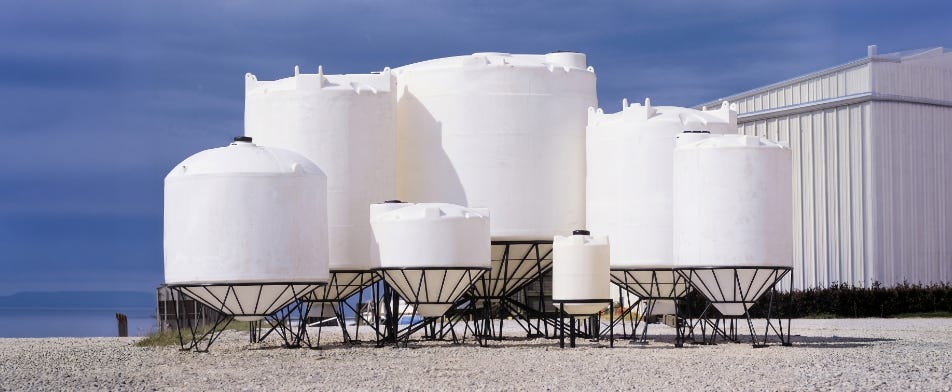
Steel stands are the heavy hitters. We build ours from heavy-gauge, powder-coated steel for high load capacity, and they carry the big, high specific gravity liquids, up to around 1.9 specific gravity (about 15.8 pounds per gallon [1.9 kg per liter]). If you run 4,000 to 8,000 gallon [15,000 to 30,000 liter] tanks, or store heavy slurries and liquid fertilizer, a steel stand is usually the only frame strong enough. The powder coat helps it shrug off weather year after year.
Poly stands are the corrosion champions. Molded from polyethylene, they never rust, never need paint, and never degrade around aggressive chemicals like sodium hypochlorite [bleach] or in humid, coastal, salty air where steel would corrode. They are lighter, easier to install, and molded to cradle the tank as one clean, food-safe system.
Quick call: heavy load or a very large tank, go steel. Corrosive product or a wet, salty, wash-down setting, go poly. Not sure, call the branch and we will match it to your liquid and your site.
Your six-answer spec checklist
Before you order an elevated cone bottom tank, have these answers ready. They turn a guessing game into a five-minute conversation.
- The liquid and its specific gravity (how heavy it is per gallon).
- Tank size in gallons [liters].
- Your design wind speed and Seismic Design Category (your building department has both).
- Indoor or outdoor, and how corrosive the setting is.
- The pad: is a level concrete slab poured and rated for the full load?
- Tie-down and bolt-down rules for your city or county.
Bring those to any Tank Depot branch and we turn them into a tank, a stand, and a restraint package that meets your code the first time, not the second.
One more place this matters: wine country
California wine country is earthquake country. The same seismic maps that govern a dairy plant in the Central Valley govern a winery in the Coast Ranges. And cone bottom tanks are workhorses for winemakers too, where the cone lets yeast and lees settle and drain clean off the bottom for clearer wine and easier cleanup.
So if you run cone bottom fermentation or settling tanks on stands anywhere in Northern California, from Mendocino County down through the valley, the same tie-down logic applies. A full tank on legs in a high seismic zone needs real anchorage, not just a level spot on the crush pad. Our Ukiah branch stocks cone bottom tanks and stands built for exactly that kind of winery and vineyard work.
Sizing Cone Bottom Tanks for Hanford, CA Dairy and Tomato Processors
Drive into Hanford at harvest and you can smell the work. Tomato trucks stack up on the county roads, the dairies run around the clock, and every one of those operations moves liquid, a lot of it, on a very tight schedule.
This is the heart of the San Joaquin Valley, and it is not a small market. California grows about 95 percent of the country's processing tomatoes and roughly a third of the world's supply. In 2025 the state harvested around 200,000 acres [81,000 hectares] and 11.6 million tons of them. Kings County, where Hanford is the county seat, ranks in the top five tomato counties in California. Right next door, Tulare County is the number one dairy county in the entire nation, with more than 335 dairies and roughly 450,000 cows. Milk and tomatoes are not a side business out here. They are the economy.
That scale runs on tanks. A cheese maker like Marquez Brothers, founded in Hanford back in 1981 and still growing (it takes milk from the California Dairies co-op and recently expanded into a second plant over in Tulare), needs clean, fully drainable vessels for batching, cultures, wash systems, and process chemicals. Tomato processors like Morning Star, the largest tomato processor in the world, move paste, additives, and cleaning solutions in bulk all season long. Both jobs are made for cone bottom tanks. Mix a batch, drain it completely out the cone, sanitize, and repeat, with no product trapped in a flat bottom to sour overnight.
Here is the catch that surprises people. Kings and Tulare counties are prime farmland, but they are also squarely in seismic country. A processor who orders a beautiful cone bottom tank and forgets the stand and the tie-downs has done half the job. A full 1,500 gallon [5,680 liter] batch tank of heavy product, up on legs, is a serious seismic load. In a shake, an unanchored stand can walk, tip, and dump a full batch across a production floor. That is lost product, a shut line, and a safety report nobody wants to write.
The fix is the same one we have been talking about all along. Match the stand to the load, pour a level pad, and add a tie-down package rated for your Seismic Design Category. For a busy dairy or cannery, we usually point to heavy-gauge steel stands for the big, high specific gravity tanks, and corrosion-proof poly stands wherever wash-down water and cleaning chemicals would eat steel alive. The right combination keeps the line running and the inspector happy.
If you process milk, tomatoes, or anything else in the Central Valley, the Tank Depot branch in Hanford has the cone bottom tanks, the steel and poly stands, and the tie-down hardware on the ground and ready to load. Tell the Hanford team your liquid, your batch size, and your local code, and they will size the whole system, tank, stand, and restraint together, so it drains clean and stays put when the ground moves.
Buy the stand like you buy the tank
An elevated cone bottom tank is a system, not a single part. The tank drains your product clean. The stand and the tie-downs keep it upright through the worst wind or the worst quake your site will ever see. Spec all three together and you buy it once. Spec the tank alone and you may end up buying it twice. Tell us your liquid, your gallons, and your ZIP code, and any Tank Depot branch will match you to a cone bottom tank, the right steel or poly stand, and a wind and seismic tie-down package that meets your local code.


